
Forex Trading Unveiled: The Ultimate Guide to How It Really Works
The Pain: Stagnation in a Dynamic World
Traditional paths to wealth-building often feel slow, inaccessible, or out of your control. Savings accounts offer minimal returns, the stock market can be intimidating and capital-intensive, and real estate requires significant upfront investment. This creates a frustrating gap between your financial aspirations and your perceived ability to achieve them. You crave agency, the ability to take direct action to improve your financial standing, but lack a clear, structured entry point into the world of active trading.
What is Forex Trading? The Logic of the Global Marketplace
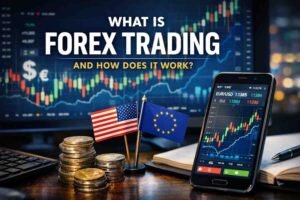
Forex, short for Foreign Exchange, is the decentralized global marketplace where national currencies are traded. It is, by far, the largest and most liquid financial market in the world, with a daily trading volume exceeding $7.5 trillion. Unlike stock exchanges, forex has no central physical location; it operates 24 hours a day, five days a week, through an electronic network of banks, institutions, and individual traders.
At its core, forex trading is the simultaneous buying of one currency and selling of another. These currencies are traded in pairs, such as EUR/USD (Euro vs. US Dollar) or GBP/JPY (British Pound vs. Japanese Yen). The goal is to profit from changes in the exchange rate between the two.
Key Participants in the Forex Market
- Commercial & Investment Banks: The largest players, facilitating transactions for clients and trading for their own accounts (interbank market).
- Central Banks: Like the Federal Reserve or ECB, they influence currency value through monetary policy and interest rates.
- Multinational Corporations: They trade currency to hedge against risk when operating in different countries.
- Retail Traders: Individuals like you and me, trading through online brokers. We now have unprecedented access to this market.
How Does Forex Trading Work? The Mechanics
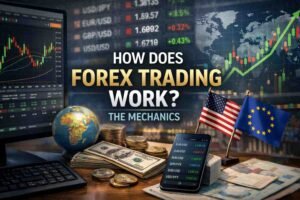
Forex trading works through a network of connected terminals and computers. Here’s a logical breakdown of the process:
1. The Currency Pair
Every trade involves a pair. The first currency listed (e.g., EUR in EUR/USD) is the base currency. The second is the quote currency. The price quoted is how much of the quote currency is needed to buy one unit of the base currency. If EUR/USD is 1.0850, you need 1.0850 US dollars to buy 1 euro.
2. Going Long or Short
- Going Long: You buy the currency pair, expecting the base currency to appreciate against the quote currency.
- Going Short: You sell the currency pair, expecting the base currency to depreciate against the quote currency.
3. Leverage and Margin
This is a fundamental concept. Leverage allows you to control a large position with a relatively small amount of capital (your margin). For example, 50:1 leverage means you can control $50,000 with a $1,000 margin deposit. It magnifies both profits and losses, making risk management paramount.
4. Pips and Lots
Price movements are measured in “pips” (percentage in point). For most pairs, a pip is a 0.0001 change. Trades are executed in standardized “lots.”
| Lot Size | Units of Base Currency | Value per Pip (approx. for EUR/USD) |
|---|---|---|
| Standard | 100,000 | $10 |
| Mini | 10,000 | $1 |
| Micro | 1,000 | $0.10 |
What Moves the Forex Market? The Driving Logic
Currency values fluctuate based on supply and demand, driven by:
- Macroeconomic Factors: Interest rates, inflation, GDP growth, and employment data.
- Geopolitical Events: Elections, trade wars, and conflicts.
- Market Sentiment: Risk-on vs. risk-off attitudes.
- Technical Factors: Support/resistance levels and chart patterns identified by traders.
The Emotion: From Confusion to Confidence and Control
Every trader begins their journey feeling confused, overwhelmed by market movements, charts, and constant decision-making. This emotional uncertainty often leads to hesitation, fear, or impulsive trades driven by guesswork rather than strategy. Over time, as knowledge increases and experience grows, confusion gradually turns into confidence. Traders start trusting their analysis, understanding risk, and accepting losses as part of the process. With consistent practice and emotional discipline, confidence evolves into control—where decisions are made calmly, emotions are managed effectively, and trading becomes a structured, rule-based activity rather than an emotional reaction to the market.